
Vericoding services
AI writes more code than a person can review.
Software development has changed. Models now produce more code than a team can read, and a review that cannot keep up is not a review. Vericoding is how you still know what the program does.
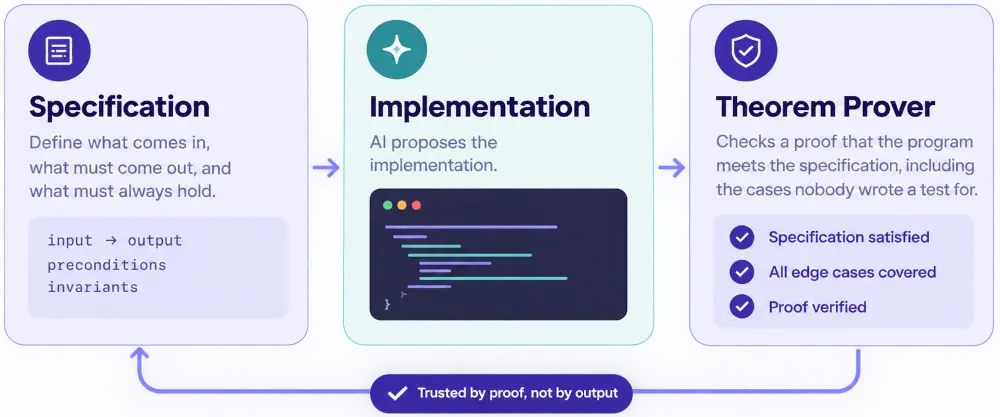
Understand it through the surface
You do not read the generated program line by line. You read the specification: what comes in, what must come out, and what must always hold. That surface is small enough to agree.
AI proposes the implementation. A theorem prover then checks a proof that the program meets the specification, including the cases nobody wrote a test for. The output is not trusted because a model wrote it. It is accepted because the proof holds.
The services below are that method applied where it matters: correctness, where the property itself is the result, and speed, where a faster program is allowed only when the same property still holds.
Correctness
The specification is the property that must hold. The proof is how you know the program does.
API Workflow Verification
Check one workflow that spans several systems, and find the retry, cancellation or late event that leaves payment or access in the wrong state.
Read the serviceVerified Security
Prove a reusable security component once, then adapt the evidence for every product that uses it.
Read the serviceDocument Workflow
Cite each fact from the source document, and check the workflow that passes it to later processes.
Read the serviceSpeed
The specification stays fixed. A faster program is accepted only when it is proved to meet that same specification.
C & Rust Speedup
Cut latency in C and Rust services and prove the result still meets its specification, or you pay nothing.
Read the serviceDatabase Speedup
Compile a high-volume query and prove it returns the same rows, values and errors as the database.
Read the serviceFaster Spatial Queries
Compile a high-volume spatial query and prove it returns exactly what the database returns.
Read the service